

Recruitment agency fees are frequently shrouded in ambiguity, making it difficult for sales directors to evaluate true hiring ROI. Across the UK, agency fees vary dramatically depending on the commercial model, role seniority, guaranteed basic salary, and the depth of candidate vetting involved.
While generalist recruiters calculate fees on simple percentages, hiring high-performing sales professionals requires a structured approach. As a specialist sales recruitment agency, Citrus Connect has managed 3,500+ placements since 2009. This guide breaks down standard recruitment fees UK employers face, explains how pricing models work, and details what businesses should expect when investing in external sales recruitment.
How Are Recruitment Agency Fees Calculated?
In the UK, traditional recruitment agency fees are usually calculated as a percentage of the candidate’s guaranteed basic starting salary:
Starting Basic Salary x Agreed Fee Percentage = Recruitment Fee
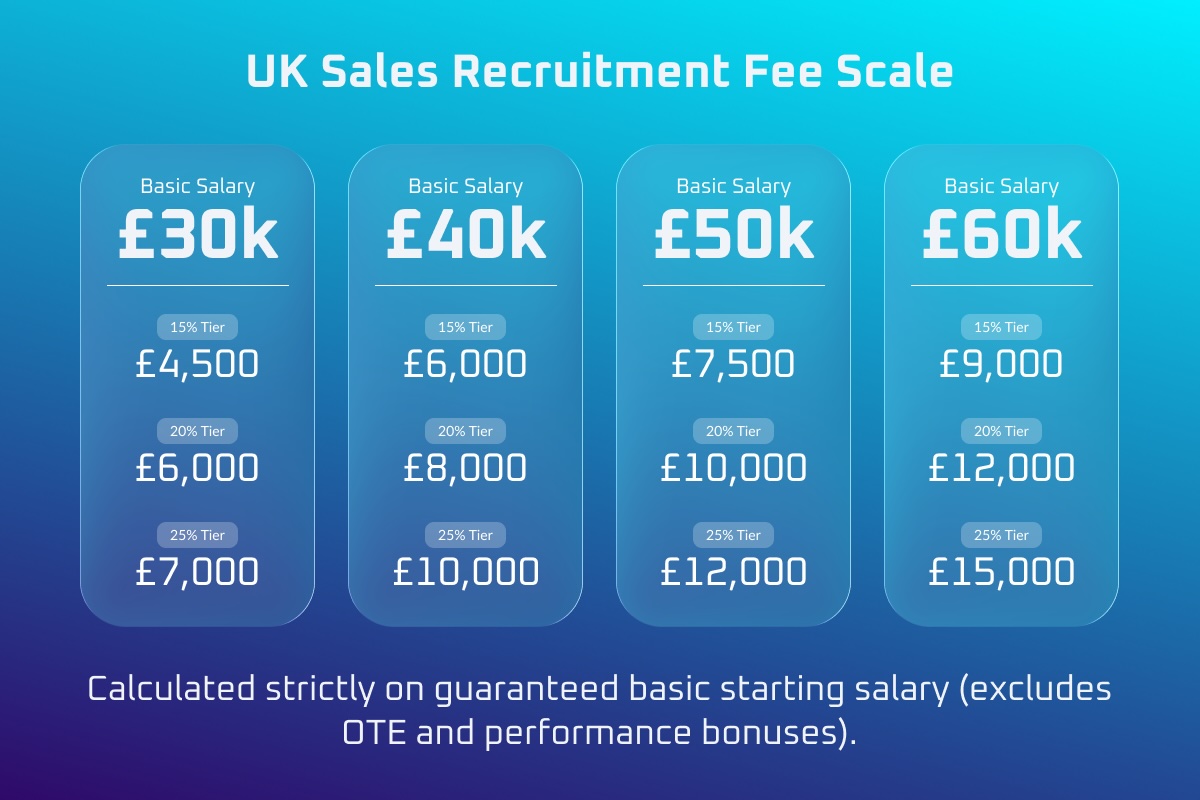
For example, if an agency charges a 20% fee to recruit a sales representative with a £40,000 basic salary, the recruitment invoice total is £8,000.
Illustrative UK Recruitment Fee Scale
The table below illustrates percentage-based fees across standard basic salary bands for sales roles we recruit for, based on UK recruitment benchmarks:
What Is the Average Recruitment Agency Fee in the UK?
Contingency recruitment fees in the UK are commonly quoted at 15% to 25% of a candidate’s first-year base salary, though some agencies calculate them on total package. Published rate cards at larger agencies can run to 30% or more for senior and specialist roles. In our experience of the sales market, fees typically break down like this:
- Standard roles (15%–18%): entry-level or high-volume positions where suitable candidates are readily available.
- Specialist and mid-level sales (around 20%): experienced field sales, territory managers and sales designers who need proactive headhunting.
- Senior leadership and executive search (25%–30%): sales directors and niche technical specialists.
The headline percentage isn’t the only cost to weigh. Across 3,500 placements tracked over 17 years, our data demonstrates that unvetted interviews and poor candidate alignment drain thousands in lost revenue. By shifting from volume sourcing to precision screening, Citrus Connect increased average candidate interview attendance from 73% in 2025 up to 85% in 2026 YTD – cutting candidate no-shows from one in four down to roughly one in seven. Before choosing on price alone, evaluate how the fee is structured: whether you are forced to pay 100% upfront and fight for a rebate, or whether terms are split across retention milestones to protect your cash flow.
What Affects the Cost of Sales Recruitment?
Several factors influence the final cost when hiring sales professionals across the UK:
Salary and Seniority
Higher basic salaries naturally result in higher fee values when percentage pricing is used. Senior roles also require deeper market research and discreet headhunting.
Role and Specialism
Recruiting self-employed direct sales agents, field sales consultants, or luxury sales designers requires specific candidate profiling. Agencies with active databases of vetted performers reduce search timelines.
Candidate Availability
In competitive markets like renewables, mobility, and home improvements, top closers are rarely actively job-hunting. Reaching passive candidates requires direct outreach rather than passive job adverts.
Location
Candidate density and travel commitments vary across regions. Finding field reps across sprawling rural territories requires wider search parameters than filling city-based desks.
Number of Hires
Employers seeking to build a high-performing sales team across multiple territories can often negotiate structured milestone pricing rather than paying standard single-placement rates.
What Are the Different Recruitment Agency Fee Structures?
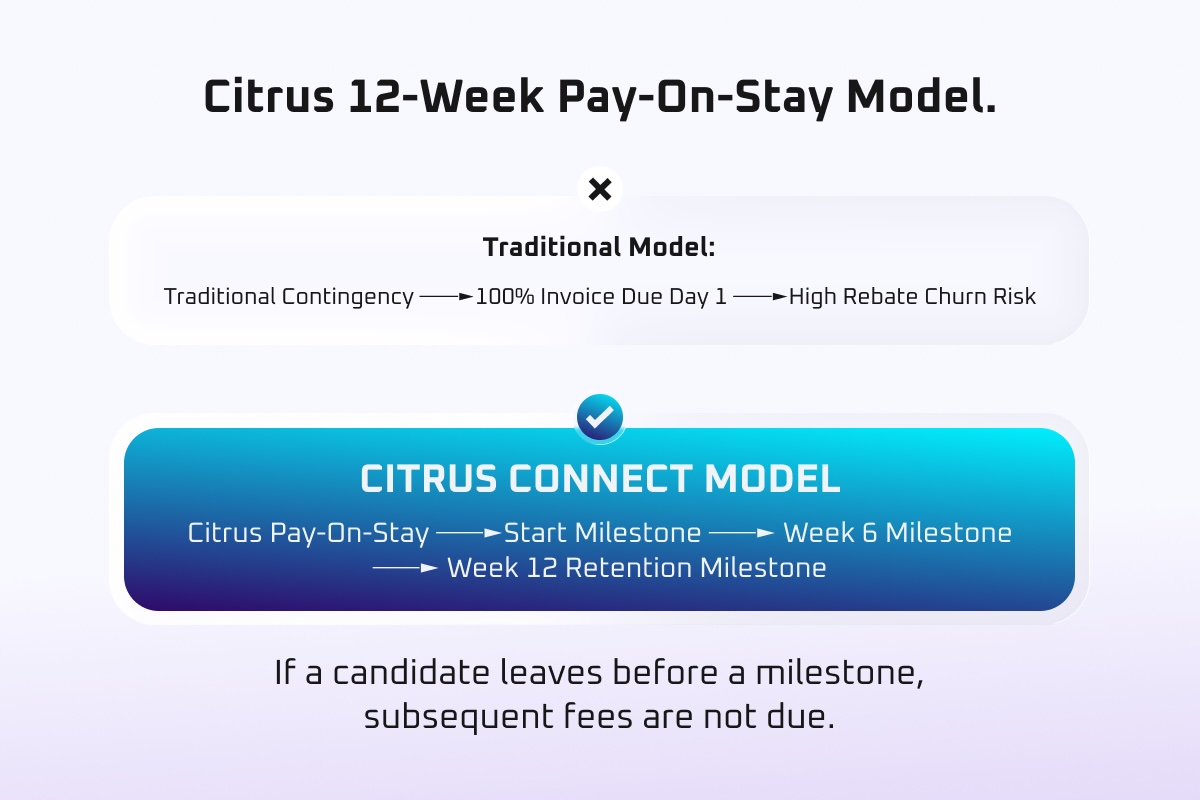
How an agency structures its fees dictates where its financial incentives lie. Traditional contingency models prioritise placement speed, whereas milestone-based models tie agency remuneration directly to 12-week candidate retention.
Contingency Recruitment
The agency works on a “no win, no fee” basis, invoicing 100% of the fee when the candidate starts. While this carries zero up-front cost, it incentivises recruiters to prioritise speed over candidate retention.
Retained Recruitment
The employer pays the fee in three staged instalments (typically one-third on instruction, one-third on shortlist delivery, and one-third on completion). This model is common for executive hires.
Milestone & Pay-On-Stay Models
To eliminate the financial risk of early candidate drop-off and ensure employers pay only for representatives who perform and stay, Citrus Connect operates a 12-week Pay-On-Stay structure:
- Initial Start Milestone: A small initial fee upon candidate commencement.
- Week 6 Milestone: A secondary payment once onboarding is complete.
- Week 12 Retention Milestone: The final balance is paid only when the representative is performing at week 12.
What Does Our Recruitment Agency Fee Cover?
A specialist recruitment fee should cover far more than scraping generic CVs off job boards. When partnering with a direct sales specialist, your fee funds a dedicated diagnostic and headhunting operation built to protect 12-week candidate retention and keep your territories filled:
- Company Role Pack Development: Before contacting candidates, we audit the employer’s sales model, commission clearance cycles, geographic coverage, and earnings data to create a comprehensive role pack. This ensures candidates receive an accurate representation of the role before the interview.
- Proprietary Sales Database Search: Immediate headhunting access across Citrus Connect’s database of 100,000+ verified direct sales professionals, built across 17 years of specialist UK market placement tracking.
- Sales-Specific Screening & Vetting: In-depth multi-stage vetting that evaluates travel tolerance, commission resilience, and realistic earnings expectations – filtering out the early drop-off risks before shortlisting.
- High-Conversion Shortlisting: Because candidate matching is precise, employers avoid conducting dozens of wasteful interviews. Drawing directly from Citrus Connect’s client accounts, candidate interview attendance sits at 85% (reaching up to 94% on key accounts like Comfomatic) with a 75%–80% offer rate from interview.
- Post-Offer Alignment: Managing offer negotiations, candidate briefings, and start-date logistics while adhering to REC Professional Membership standards.
To review how our six-step recruitment framework operates in practice, explore how we build sales teams.
Is Using a Sales Recruitment Agency Worth the Cost?
Evaluating a recruitment fee isn’t an abstract exercise; it comes down to simple territory math. Across Citrus Connect’s direct sales client accounts, an unallocated field territory drains an estimated £15,000 per month in lost gross margin. Leaving a territory sitting open for 90 days while relying on generic internal job boards costs £30,000+ in lost revenue, dwarfing any specialist recruitment fee.
- The Cost of Extended Vacancies: Filling a specialist field sales role through general job boards often extends time-to-hire past 60 to 90 days, accumulating £30,000+ in lost sales revenue. Citrus Connect’s internal performance data shows our average time-to-shortlist is 21 days, placing productive sales reps into the field weeks faster.
- The Hidden Cost of Early Attrition: In direct sales, early candidate drop-out is exceptionally high when expectation alignment is poor. Replacing a failed hire costs twice as much in lost leads, unserviced territories, and retraining. Our 2025 vs. 2026 performance data proves that setting accurate expectations upfront reduces interview no-shows from 27% down to 15%. Working with an agency that structures terms around 12-week retention – such as our 100% 12-week retention outcome with Oak Tree Mobility – mitigates this risk entirely.
- Management Opportunity Cost: Spending 30+ hours of a Sales Director or Business Owner’s time filtering unqualified CVs diverts leadership away from managing live deals and growing the business.
To calculate potential hiring risks before committing budget, read our guide on how to avoid costly hiring mistakes.
What Should You Ask a Sales Recruitment Agency About Its Fees?
Before signing terms with any recruitment agency, ask these six questions to clarify terms:
- How are your fees calculated? (Is the fee based on basic salary or total OTE?)
- When does the fee become payable? (100% on day one or split across retention milestones?)
- What happens if a hire leaves within 12 weeks? (Are you forced to chase a partial rebate, or do fees stop automatically?)
- Who pays for job board advertising and headhunting outreach?
- What is your documented candidate retention rate at 12 weeks?
- Do you hold REC Professional Membership?
For more insights on evaluating recruitment partners, view our sales recruitment advice for employers.
Conclusion
A recruitment agency fee is only as valuable as the candidate retention it delivers. While standard UK contingency fees sit between 15% and 25%, paying 100% upfront on day one places all the financial risk on the employer. Choosing a recruitment partner whose commercial model is tied directly to 12-week candidate performance protects your P&L and keeps your sales territories filled.
If you are expanding your sales team and require verified sales professionals who stay and perform, discuss your hiring plans with our team.
Book a Call with Citrus Connect today to explore our Pay-On-Stay recruitment structure.
FAQs About Recruitment Agency Fees
How much do recruitment agencies charge in the UK?
UK recruitment agency fees typically range between 15% and 25% of a candidate’s basic starting salary. The exact percentage depends on the role level, industry specialism, and search complexity.
How much commission do recruitment agencies charge?
Agencies charge a placement fee rather than taking a cut of the candidate’s ongoing sales commission. Fees are calculated as an agreed percentage of the starting basic salary or structured as fixed milestone payments.
Who pays recruitment agency fees?
Recruitment agency fees are paid exclusively by the hiring employer. Under UK law (specifically the Conduct of Employment Agencies and Employment Businesses Regulations on GOV.UK), it is illegal to charge candidates a fee to find or apply for employment.
When do you pay a recruitment agency?
Under traditional contingency terms, fees are due within 14–30 days of the candidate’s start date. Under a Pay-On-Stay structure, fees are split across start, week 6, and week 12 milestones.
Are recruitment agency fees negotiable?
Fees can be negotiated based on volume, exclusivity, or long-term hiring commitments. However, reducing fees with traditional agencies often results in lower priority being given to your vacancy.