

Building a self-employed direct sales team requires far more than publishing a generic job advert for commission-only reps and hoping high performers apply. Traditional salaried recruitment strategies fail when applied to independent field sales agents, door-to-door (D2D) canvassers, or appointment-led sales designers. Independent sales reps operate as independent business owners across their designated postcodes; they carry their own financial risk, manage their own working patterns, and decide where to direct their daily effort.
Across 3,500+ direct sales placements made since 2009 and a curated UK candidate database exceeding 100,000 sales professionals, our recruitment metrics show that high-performing teams are built through deliberate structure, transparent financial expectations, and disciplined operational execution. If you are evaluating how to build a sales team on a self-employed, freelance, or commission-based structure, this guide outlines the practical process required to define, attract, screen, onboard, and retain direct sales talent across the UK.
What Is a Self-Employed Direct Sales Team?
A self-employed direct sales team consists of independent contractors, commission-only sales agents, or freelance sales representatives who sell products or services directly to business-to-consumer (B2C) or business-to-business (B2B) buyers. Unlike internal salaried sales functions structured around SDRs, Account Executives, and fixed basic salaries, self-employed teams operate entirely on performance payouts – typically through uncapped commission structures, fee-per-sale agreements, or commission paired with performance retainers.
In the UK market, these sales forces dominate key sectors including home improvements, renewable energy, healthcare and mobility, telecommunications, and more. Sales professionals accept financial self-reliance in exchange for autonomy, geographic flexibility, and uncapped income potential. For employers, adopting this model minimises fixed payroll overheads and aligns recruitment investment directly with closed revenue, but it demands an attractive proposition to draw high-calibre talent.
Is a Self-Employed Sales Team Right for Your Business?
A self-employed sales model is not a shortcut to zero-cost lead generation or cheap customer acquisition. Before initiating a recruitment strategy, employers must assess whether their operating model can support independent sales agents.
- Sufficient Product Margins: Your product or service must offer high unit margins or substantial average order values, such as solar panel installations, fitted furniture, or home mobility equipment, to fund competitive commission payouts.
- Pre-Qualified Lead Infrastructure: Top-performing commission-only agents want to close deals, not spend 30 hours a week cold-calling or self-generating leads. Companies supplying pre-screened consumer appointments or managed field territories retain sales reps at significantly higher rates.
- Broad Geographic Territory Coverage: Restricting recruitment to narrow postcode regions limits your candidate pool. Data from our workforce planning audits shows that successful employers actively recruit across 20 to 40+ UK postcodes simultaneously to build continuous talent pipelines.
- Realistic 60-Day Earning Horizons: Independent agents evaluate opportunities based on speed to earnings. Your model must allow a competent sales professional to secure their first commission payouts within their initial 30 to 60 days.
How to Build a Self-Employed Sales Team
Building a high-performing freelance direct sales team requires a systematic framework spanning role definition, opportunity creation, targeted sourcing, and objective selection.
Define the Salespeople You Need
Relying exclusively on standard CVs and previous job titles severely restricts your talent pool. Our screening data across 100,000+ candidates demonstrates that direct sales performance correlates far more strongly with core behavioural drivers than traditional resume experience.
Using our G.E.M.S. profiling framework, we categorise candidates by their dominant working styles and motivational drivers:
- Emeralds (Analytical & Process-Driven): Represent 68% of top-converting sales designers in B2C fitted home products. Emeralds excel because they master technical product specifications, respect structured sales processes, and build client trust through analytical precision.
- Rubies (Results & Driven by Competition): Account for 34–38% of top revenue generators in competitive field sales. Rubies are motivated by financial independence, direct effort-to-earning ratios, and high-performance leaderboards.
- Proven Candidate Avatars: Look beyond conventional salespeople. Candidate profiles such as ‘Dave’ (skilled tradespeople seeking to transition off manual labour into sales), ex-military personnel (accustomed to rigid discipline and field autonomy), or ex-retail managers seeking uncapped income consistently match or outperform traditional sales reps when supported by product training.
Create an Opportunity Worth Joining
High-performing self-employed salespeople have choices. To attract experienced professionals away from competing opportunities, your employer proposition must provide clear operational advantages:
- Protected Territories: Grant designated geographic boundaries so reps do not compete against internal colleagues for local leads.
- Consistent Lead Supply: Provide a predictable volume of pre-screened appointments generated via multi-channel marketing campaigns.
- Flexible Engagement Models: Offer structured options (such as full-time direct sales, top-up roles, or semi-retired schedules) that align with different lifestyles.
Set Clear Commission and Earning Expectations
Publishing exaggerated On-Target Earnings (OTE) figures without factual justification is the primary driver of early candidate drop-off. Citrus Connect placement tracking indicates that sales professionals exit within their first 4 weeks when advertised earnings fail to reflect real-world outcomes.
Always present realistic average earnings alongside top-performer benchmarks. Clearly detail commission tiers, lead allocation rules, discount limits, and payment schedules within your introductory documentation.
Choose the Right Recruitment Channels
Reaching independent sales agents requires specialised sourcing strategies. While general job boards generate 31% of overall candidate applications, 27% of our placements originate from direct inbound enquiries and 21% from our internal candidate database.
Engaging a partner that specialises in self-employed direct sales recruitment allows employers to target passive, commission-ready sales talent across specific UK postcodes rather than relying on generic B2B recruitment methods.
Screen and Interview for Direct Sales Potential
Evaluate candidates on business acumen, negotiation discipline, and margin protection rather than raw closing volume. In our consultancy analysis across fitted luxury interior brands, shifting focus from raw conversion rates to Average Revenue Per Lead (ARPL) revealed that high conversion rates often mask heavy upfront discounting.
Screen candidates during interviews for their ability to protect profit margins, follow a structured sales process, demonstrate coachability, and maintain personal diary discipline.
Keep the Recruitment Process Moving
Speed of execution is critical when recruiting self-employed talent. Our recruitment audit data reveals a severe 49% candidate drop-out rate between inviting candidates to an interview and their actual attendance when interview decisions drag out.
While internal corporate hiring cycles frequently drag out between 60 and 90 days, our standard recruitment benchmark achieves an average time to shortlist of 21 days. Slow interview processes signal internal inefficiency, driving top-tier reps straight into competing offers. For a detailed breakdown of the candidate selection workflow, read our companion guide on hiring self-employed sales reps.
What Should You Look for in a Self-Employed Sales Rep?
Identifying successful direct sales representatives requires assessing specific behavioural indicators during selection:
- Resilience and Autonomy: The internal drive to maintain daily field activity and overcome client rejections without requiring constant managerial oversight.
- Commercial Acumen: Understanding personal profit-and-loss, travel overheads, commission structures, and deal margin protection.
- Coachability: The willingness to absorb technical product knowledge and adhere to proven sales presentation frameworks.
- Rapport Building: The capacity to build immediate trust and social connection within B2C home environments or B2B decision-maker meetings.
“Your salespeople are fundamentally your first customers. The speed, transparency, and respect you demonstrate throughout the recruitment process directly influence their initial commitment, retention, and long-term performance.” – Leena Parmar, Founder of Citrus Connect Recruitment
How to Onboard Your Self-Employed Sales Team
Recruitment represents only the initial phase of building a team. Delivering a structured onboarding programme prevents early burnout and bridges the transition between initial training and consistent commission earnings.
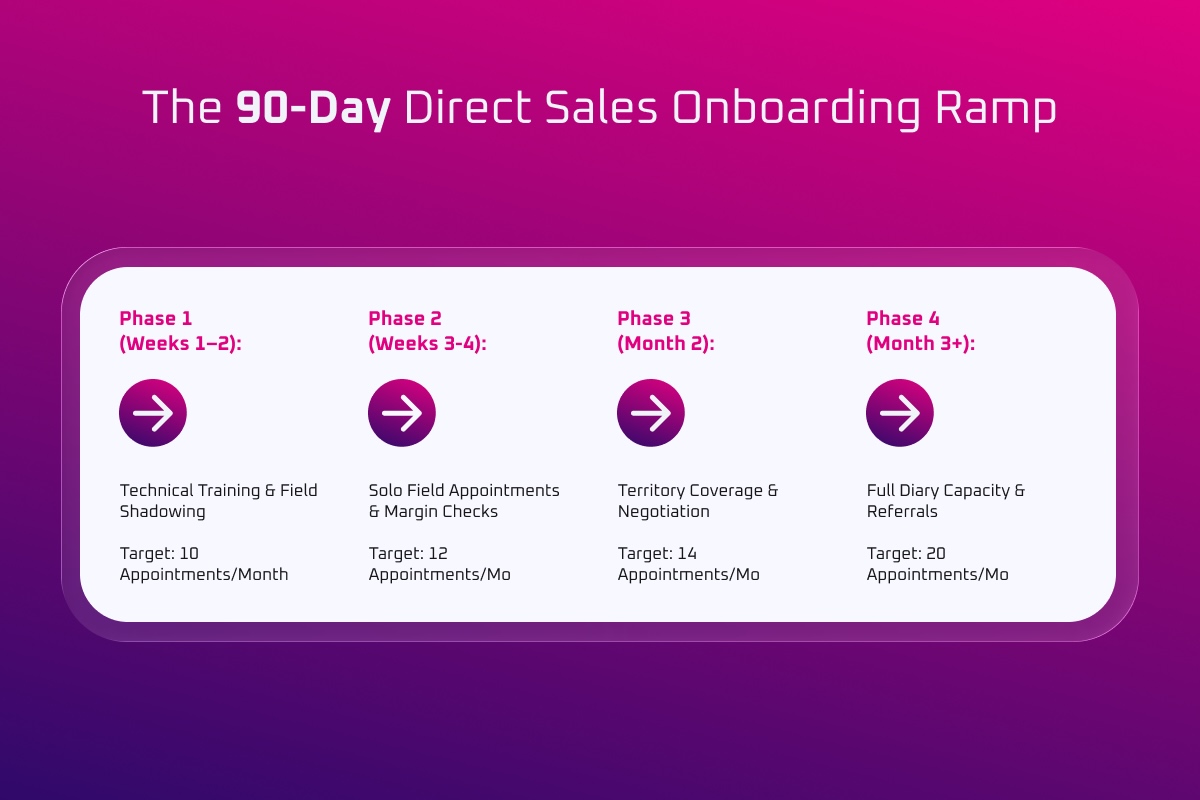
We recommend implementing a 90-day “Diary Ramp” framework that scales appointment volume alongside developer capability:
| Onboarding Phase | Operational Focus | Managed Appointment Target |
| Weeks 1–2 | Technical training, product specifications, field shadowing | 10 appointments/month |
| Weeks 3–4 | Solo field appointments, daily debriefs, margin checks | 12 appointments/month |
| Month 2 | Independent territory coverage and negotiation refinement | 14 appointments/month |
| Month 3+ | Full diary capacity, upsell optimisation, and referral generation | 20 appointments/month |
Pairing initial product training with financial goal-setting workshops helps independent agents connect daily sales activity directly to their personal financial goals. For strategic advice on ongoing field management, consult our guide on managing a self-employed sales team.
How to Retain High-Performing Self-Employed Salespeople
Retaining top commission-only sales talent requires continuous operational support. Analysis of long-term sales data indicates a noticeable performance dip in Average Revenue Per Lead among reps reaching the 3-to-5-year tenure window if they are not re-energised through advanced training, refreshed incentive structures, or mentoring roles.
Key retention drivers include:
- Consistent Lead Quality: Protecting appointment conversion rates by maintaining rigorous lead pre-screening.
- Structured Week-4 Check-Ins: Conducting proactive reviews at week four catches early operational friction before reps decide to exit.
- Prompt Commission Payments: Ensuring commission calculations and fee payouts occur accurately and on time.
Establishing robust retention processes enables companies to expand sustainably, mirroring our work scaling a sales team from 4 to 40 reps while maintaining high performance standards.
Common Mistakes When Building a Self-Employed Sales Team
Employers frequently undermine their direct sales recruitment campaigns by making preventable operational mistakes:
- Inflated Earning Claims: Promoting theoretical maximum earnings rather than realistic OTE benchmarks creates immediate distrust and early candidate churn.
- Sluggish Interview Cycles: Allowing more than 48 hours to elapse between candidate submission and interview invitations causes severe funnel leakage.
- Zero Lead Provision: Expecting independent agents to build territories entirely from cold prospecting without company marketing support.
- Treating Reps Like Salaried Employees: Mandating rigid internal reporting without providing guaranteed basic compensation compromises their self-employed status.
Avoid these common operational traps by reading our overview on avoiding costly hiring mistakes.
When Should You Use a Specialist Direct Sales Recruitment Agency?
Managing direct sales recruitment internally becomes inefficient when scaling rapidly, filling recurring monthly induction intakes, or attempting to recruit across challenging regional postcodes. Specialist recruitment agencies bring pre-screened candidate databases, objective assessment tools, and deep sector experience across field sales and direct sales models.
If your organisation needs to build your sales team with qualified field sales or self-employed sales professionals, Book a Call with our specialist team today to review your hiring requirements.
Frequently Asked Questions
- How do you build a successful self-employed sales team? Define clear candidate profiles, establish transparent commission structures, supply pre-qualified appointments, maintain interview turnarounds under 21 days, and execute a structured 90-day onboarding programme.
- How do you recruit self-employed salespeople? Sourcing requires targeting specialised candidate databases, running geo-targeted vacancy campaigns with factual earning transparency, and tapping into active field sales networks rather than relying on B2B job ads.
- What should you look for in a self-employed sales rep? Focus on resilience, coachability, commercial acumen, and alignment with proven behavioural profiles, such as analytical Emeralds or competitive Rubies, rather than CV job titles alone.
- How do you retain self-employed salespeople? Maintain reliable lead quality, execute structured check-ins at week 4, address the 3-to-5-year tenure engagement gap, and ensure accurate, timely commission payments.