Disclaimer: This article provides general information only and does not constitute legal or tax advice. Employment status depends on the circumstances of each working relationship.
If your sales reps are self-employed or paid on commission only, you rely on one assumption every day: that they really are self-employed. A consultation published on 14 October 2026 could make that harder to defend.
The proposals would put the burden on the business to show someone is genuinely self-employed when status is disputed. Nothing has changed in law yet, and the current rules still apply. But the consultation closes on 8 January 2027, so now is the time to check how your reps work in practice, and to have your say.
A self-employed sales model is not a shortcut to cheap customer acquisition. Even where the business supplies pre-screened appointments, self-employed agents carry their own financial risk and trade a guaranteed salary for uncapped earnings. The costliest mistake is treating them like salaried staff. The moment you impose shift rotas, demand office attendance or penalise reps for declining leads, you put their self-employed status at risk.
What the consultation proposes
On 14 October 2026, the government published Make Work Pay: employment status reform and protections for the self-employed. It covers employment rights only, not tax. The main proposals are:
- A presumption of worker status. In a tribunal, the business would have to show someone is not a worker, rather than the individual proving they are. It would cover rights that flow from worker status, such as holiday pay, not employee rights such as unfair dismissal.
- Less weight on personal service. Control would count alongside it early in the test, so a broad substitution clause could no longer defeat worker status on its own.
- Written statements for the self-employed. Certain self-employed people would have a right to key terms in writing, such as scope of work, payment and termination.
For firms with self-employed field teams, the presumption is the headline. If a rep’s status is challenged, you would need to show they are genuinely self-employed.
What remains open: the detail. The consultation asks, for example, who written statements should cover, and whether the presumption should depend on conditions such as direction and control. It closes at 11:55 pm on 8 January 2027. The government will then respond, and any change in law would follow. Until then, the current tests apply.
Other key dates for sales employers
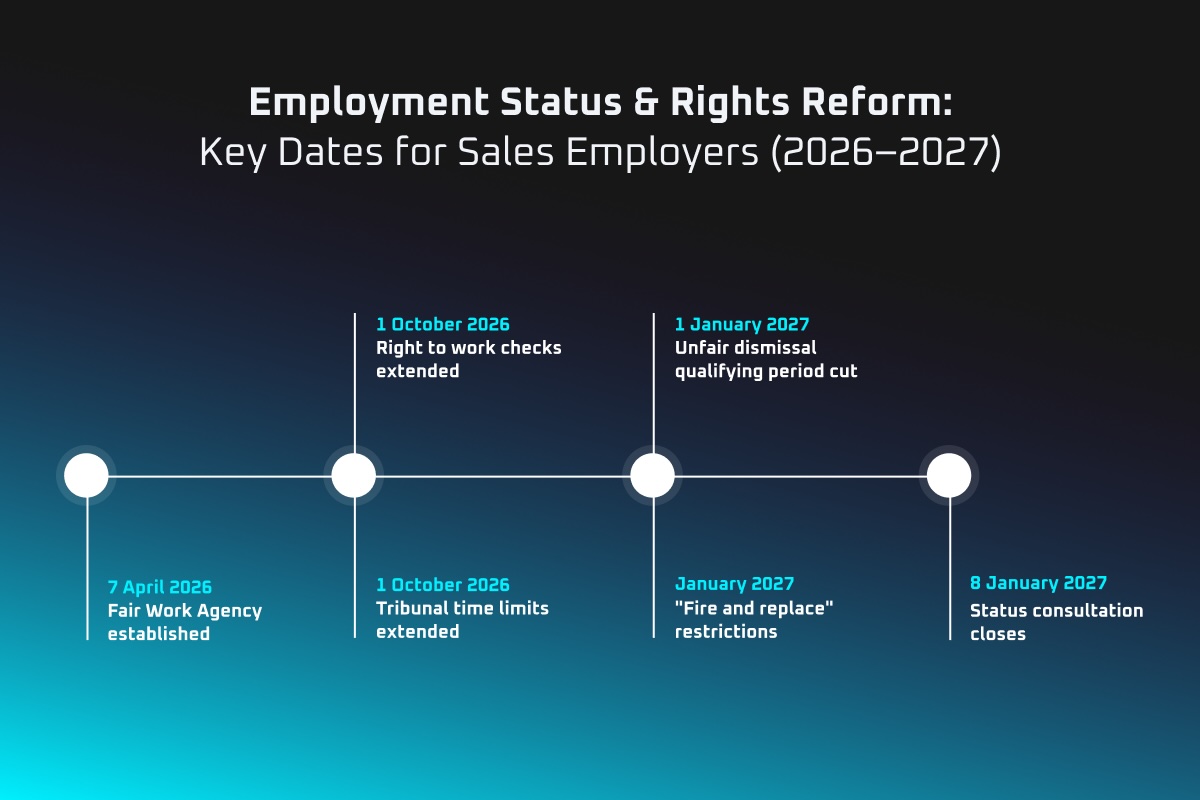
Separately from status reform, these changes are under way or due, mostly under the Employment Rights Act 2025.
| Date | Change | What it means for sales employers |
| 7 April 2026 | Fair Work Agency established | Enforces the minimum wage now. Holiday pay enforcement is expected from 2027, with proposed penalties of 200% of arrears, capped at £20,000 per worker. |
| 1 October 2026 | Tribunal time limits extended | Broadly from 3 to 6 months for acts on or after this date (Scottish breach of contract claims from 9 November 2026). |
| 1 October 2026 | Right to Work checks extended | Now covers individual sub-contractors, and substitutes where substitution is allowed, for engagements starting on or after this date. Penalties are up to £45,000 per worker, or £60,000 for repeat breaches. Final guidance is awaited, so check how your reps are engaged. |
| 1 January 2027 | Unfair dismissal qualifying period cut | From 2 years to 6 months for dismissals on or after this date, and compensation caps removed. |
| January 2027 | “Fire and replace” restrictions | Delayed from October 2026. Expected to make it automatically unfair to dismiss employees to replace them with non-employees doing substantially the same work, with narrow exceptions. |
| 8 January 2027 | Status consultation closes | Last day to respond. |
Employee, worker or self-employed: what’s the difference?
Employment status is the legal category that decides which statutory rights someone can claim and what a business owes them. For employment rights in Great Britain there are three categories. Section 230 of the Employment Rights Act 1996 defines employees and workers; self-employment isn’t defined in legislation. Northern Ireland has separate rules.
- Employee: works under an employment contract, with the widest protection. Unfair dismissal needs qualifying service: two years now, six months from 1 January 2027.
- Worker (“limb (b)”): does work personally for someone who isn’t a client or customer of their own business. Gets core rights from day one, including the minimum wage, paid holiday and pension auto-enrolment.
- Self-employed: runs their own business, with generally no statutory employment rights beyond some health and safety and anti-discrimination protection.
| Employee | Worker (limb b) | Self-employed | |
| Control | Employer has ultimate control | Some control, more flexibility | Significant freedom |
| Personal service | Must do the work personally | Generally personal; limited substitution | Can send someone else |
| Minimum wage and holiday pay | Yes | Yes | No |
| Financial risk | Usually limited | May bear some | Carries risk, covers own costs |
When could a self-employed salesperson be a worker or employee?
There is no single test or trigger. Tribunals weigh the whole relationship, and day-to-day practice often drifts from the contract. No one answer settles status, but these five questions make a useful audit.
- Control: hours and meetings. Do reps plan their week around appointments, or face shift rotas or, for example, a mandatory 8:30 am huddle? Fixed hours and compulsory meetings may suggest worker or employee-style control.
- Mutual obligation: lead allocation. Can reps accept or decline leads? If the business must offer work and reps must take every allocated slot, that may point towards employee status.
- Personal service and substitution. Can reps genuinely send someone else, and do they ever? A substitution right only helps if it is realistic in practice. Proposed change: the consultation would give personal service less weight, so a broad substitution clause could no longer defeat worker status on its own.
- Method and exclusivity. Can reps choose how they sell, or face rigid script monitoring and compulsory ride-alongs? Can they sell for other firms? Are they subject to internal disciplinary procedures?
- Financial risk, pay and equipment. Do reps cover their own costs and carry real risk on unclosed leads? The consultation also asks whether being able to set or negotiate your own pay is a key dividing line, so commission rates set entirely by the business deserve a second look. Business-supplied equipment can count too: in R W Proffitt Ltd v Secretary of State for Social Security, TV salesmen given cars were found to be employed, the cars being one important factor (HMRC Employment Status Manual, ESM0540). In sales, think company cars or demo kits.
Reading those questions, many businesses assume keeping reps self-employed means leaving them to fend for themselves. It doesn’t. The firms whose reps last focus on what they commit to provide, not what they require. That means enough qualified appointments to build a real pipeline, an agreed area that isn’t overcrowded, an open door if a rep wants to talk through what isn’t working, and commission paid accurately and on time, every time. Support offered is very different from control imposed.
Commission-only pay and the minimum wage
Genuinely self-employed agents aren’t entitled to the National Minimum Wage, but workers paid on commission are. Acas confirms commission counts towards it, and pay must reach the minimum wage on average across each pay reference period (see GOV.UK’s guidance on calculating the minimum wage).
So if a tribunal finds a “self-employed” rep is legally a worker, a commission-only model could mean topping up pay to £12.71 an hour (aged 21 and over) or £10.85 (aged 18–20), the rates from April 2026. For minimum wage claims, the law already presumes someone qualifies unless the business shows otherwise (National Minimum Wage Act 1998, section 28). The consultation proposes something similar for other worker rights.
Labels, contracts and tax status
Calling someone a “self-employed sales representative”, “consultant” or “independent contractor” doesn’t by itself decide their status. Courts look at how the relationship works day to day, and can disregard written terms that don’t reflect it (Autoclenz v Belcher [2011] UKSC 41). Only courts and employment tribunals can make a final decision.
Tax status is a separate question. Tax has two categories, employed or self-employed, decided by HMRC and the tax tribunals. Employment rights have three, decided by employment tribunals and courts. So a rep can be self-employed for tax yet still hold worker rights. The consultation doesn’t propose changing tax status, and HMRC’s Check Employment Status for Tax (CEST) tool covers tax only.
What should employers with self-employed sales teams do now?
- Respond to the consultation by 8 January 2027, online or at [email protected]. The sections on personal service, the presumption of worker status and written statements matter most for sales teams.
- Audit how reps actually work using the five questions above, not just what the contract says.
- Check your Right to Work process covers reps and any substitutes engaged since 1 October 2026.
- Put key terms in writing and update them whenever practice changes, so contracts reflect reality.
- Keep status under review, as the GOV.UK employer checklist advises.
- Take specialist legal or tax advice where status is unclear.
How Citrus Connect can help
A role described as it really works is far easier to defend. That’s why honest role packs and realistic earnings expectations matter so much in a self-employed model.
At Citrus Connect Recruitment, we specialise in UK direct sales recruitment across home improvements, renewable energy, healthcare, mobility and more. We help design realistic role packs, set honest earnings expectations and attract commission-ready sales talent who perform and stay. We’re recruiters, not lawyers, so we’ll always point you to specialist advice on status.
If you’re building or reviewing a self-employed sales team, talk to us before the consultation closes on 8 January 2027. Book a Call today.
Frequently asked questions
What are the three main types of employment status? Employee, worker and self-employed, for employment rights in Great Britain.
Can you work for a company and be self-employed? Yes. Someone can provide services to a company while genuinely self-employed, but their status depends on the actual working relationship.
When does a contractor become an employee in the UK? There is no single trigger. Control, personal service, mutual obligation and financial risk are weighed together.
Does commission-only pay mean someone is self-employed? Not automatically. Pay structure is one factor. If a commission-only rep is legally a worker, minimum wage top-ups may apply.
Is the law changing? Not yet. The government is consulting on reforms until 8 January 2027. The current tests apply until any new law is passed.
How should employers check someone’s employment status? Review the real working arrangement and consider employment law and tax status separately. Use HMRC’s CEST tool for tax, and Acas guidance or professional advice for employment rights.