
When a sales hire doesn’t work out, most businesses count the recruitment fee and move on. In direct sales, the fee is usually the smallest number on the bill.
The bigger costs build up quietly: appointments you’ve paid to generate, sat by someone who can’t close them; weeks of training and shadowing; manager time; and the months it takes to find and ramp up a replacement.
At Citrus Connect, we recruit direct sales professionals every week, most of them self-employed and paid on commission. So rather than repeat a generic “a bad hire costs £X” statistic, we’ve used our own 2025 data and our clients’ sales figures to show what a bad sales hire actually costs.
How much does a bad hire cost?
Based on our clients’ figures, every appointment a struggling sales rep sits can cost around £3,200 in sales a strong rep would have closed.
That’s because a strong rep converting 65% of appointments at an £8,000 average order value brings in around £5,200 per appointment. A struggling rep converting 25% brings in around £2,000.
Over a 12-week ramp-up period at 10 appointments a week, that gap adds up to between £96,000 and £384,000 in sales value. That’s before you pay to recruit, train and onboard a replacement. The exact cost of a bad hire in the UK varies by role and sector, but in direct sales the biggest cost is almost always the sales that don’t happen.
The figure is based on sales value, not profit. It shows what’s at stake, not a guaranteed loss. We explain exactly how we calculated it below.
About our data Source: Citrus Connect internal data and client sales figures Period: January to December 2025 Sample: 198 placements across 14 clients Roles: 95% self-employed or commission-only, 5% employed Limitations: Conversion rates, order values and appointment volumes are typical client figures, not averages across every placement. Results will vary by sector, product and lead quality.
This is why we put so much weight on getting the hire right first time when building a high-performing sales team.
What actually makes up the cost of a bad sales hire?
The cost of hiring the wrong person isn’t one number. Some costs are direct and easy to count. Others are indirect, and in sales they are usually much bigger.
Recruitment costs
Whether you use an agency or recruit yourself, every hire has a cost. Our fees are paid in stages over a rep’s first 12 weeks rather than all up front. Clients who recruit directly tell us they typically spend £100 to £500 per role on advertising, plus the time spent screening and interviewing.
Recruitment itself isn’t wasted money. The problem with a bad hire is that you pay many of these costs twice.
Pay and earnings
Most of the reps we place are self-employed and paid on commission, so a struggling rep may cost little in pay. But any guaranteed earnings, allowances or expenses a business offers while a new rep builds a pipeline add to the cost.
For employed reps on a basic of £25,000 to £45,000, 12 weeks of salary is roughly £5,800 to £10,400 before employer costs. Not all of that is lost, as the rep will have done some productive work.
Onboarding and training
Our clients typically give new reps five days of initial training and three days of field shadowing, although some offer none. That’s eight days of the rep’s time and a trainer’s or manager’s time. If the hire doesn’t work out, all of it has to be repeated.
Lost sales and missed targets
This is where the cost of a bad sales hire becomes very different from other roles. Our clients’ figures show:
• a strong rep converts around 65% of appointments
• a struggling rep converts around 25%
• the average order value is £8,000
That 40-point gap is worth about £3,200 in sales on every appointment. These are potential sales, not guaranteed revenue, but they are the clearest way to see what an underperforming rep costs.
Wasted sales leads
In appointment-led businesses, every lead has already cost money, whether through marketing, canvassing or a call centre. A rep who follows up slowly, fails to qualify or lets a customer go cold is wasting an investment the business has already made. Unlike a missed target, a burned lead is rarely recovered.
Management time
A struggling rep takes more of a manager’s time: extra coaching, ride-alongs, performance conversations and admin. We don’t have reliable figures for this, so we haven’t included it in our total. A simple way to estimate your own is: extra management hours per week × hourly cost × number of weeks.
Replacing the salesperson
Once the rep leaves, the cycle starts again: recruitment, interviews, onboarding, training and ramp-up. That’s the real cost of employee turnover in a sales team. On average, we create a shortlist in 7 to 10 days, but it then takes around 33 days from shortlist to start, largely because good candidates have notice to serve. Add a 12-week ramp-up for the replacement, and the territory can be under-covered for months, which is why improving sales retention saves far more than a recruitment fee.
The real cost of a bad sales hire: our numbers
Here’s what one struggling commission-only rep can cost over a 12-week ramp-up period, using the figures above.
| Cost | Figure | Basis |
| Initial recruitment | One recruitment fee | Agency fee, or £100–£500 advertising plus your time if recruiting directly |
| Onboarding and training | 8 days | Typical client training and shadowing |
| Management time | Not costed | No reliable data; use the formula above |
| Sales not closed (cautious) | £96,000 | 120 appointments × 10 points higher conversion × £8,000 |
| Sales not closed (vs a strong rep) | £384,000 | 120 appointments × 40 points higher conversion × £8,000 |
| Replacement recruitment | A second recruitment fee | The recruitment cost is paid again |
| Time to replace | About 6 weeks | 7–10 days to shortlist, then about 33 days to start |
| Replacement ramp-up | 12 weeks | Typical client figure |
| Direct cost | Two recruitment fees | Plus any guaranteed earnings or expenses you offer |
| Sales value at stake | £96,000 to £384,000 | Worked example |
How we calculated it. A new rep typically sits 10 appointments a week, so 120 over 12 weeks. At a 25% conversion rate, the struggling rep closes 30 sales. A strong rep closing the same 120 appointments at 65% would close 78. The difference is 48 sales, or £384,000 at an £8,000 average order value.
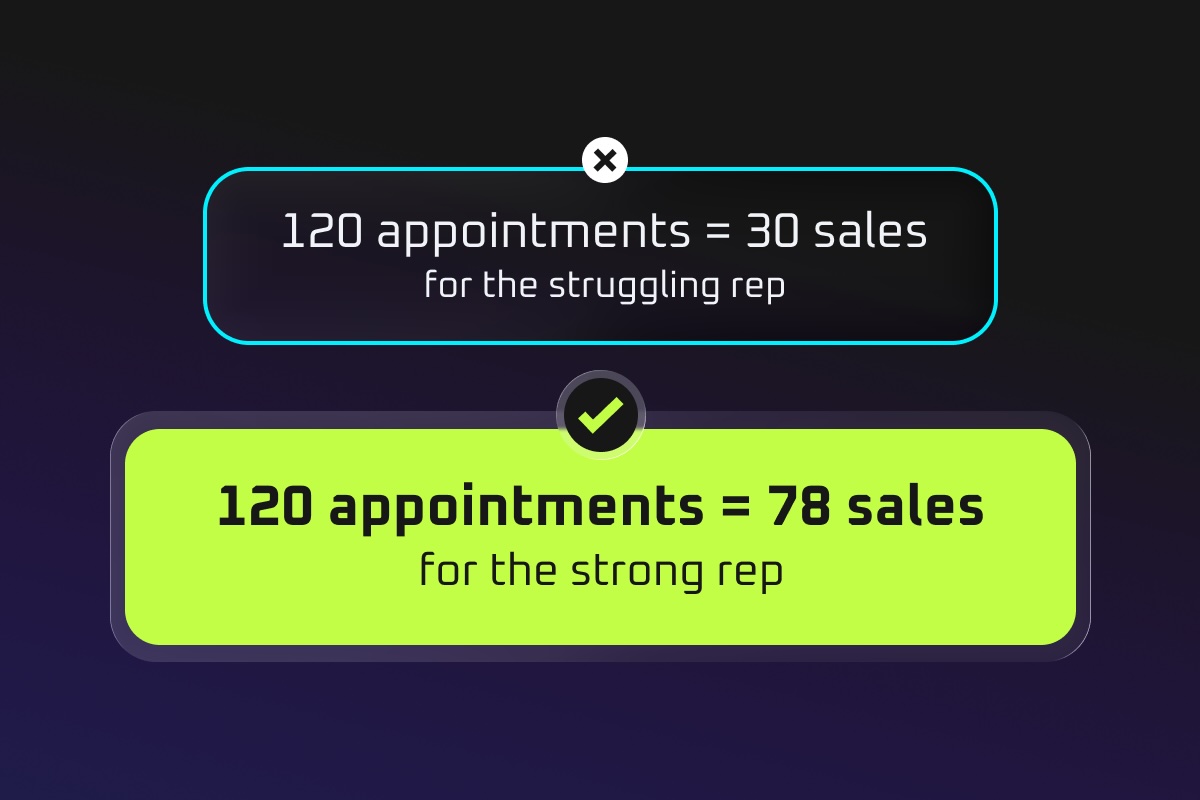
That comparison is against an established strong rep, so it’s the top of the range. A new hire is still learning too. So we’ve also shown a cautious figure: even if a better hire closed just 10 percentage points more, the gap would still be £96,000 in sales over 12 weeks.
All sales figures are sales value, not profit, and the totals are worked examples, not averages across all our clients.
It’s why I tell every client the same thing:
“The most expensive bad hire isn’t the one who leaves in week two. It’s the one who stays twelve weeks, sitting appointments a better rep would have closed.”
A rep who leaves in week two has sat 20 appointments. One who struggles on for twelve weeks has sat 120. With staged fees, the early leaver has also cost only part of the recruitment fee.
Get the right people in place and the same maths works in your favour, which is exactly what our clients have seen as they scale.
The costs that are harder to measure
Not every consequence of a bad hire needs a price tag. These are real, but we haven’t tried to put a number on them.
• Customer relationships. In direct sales, the rep is your business in the customer’s home. A poor experience affects how that customer, and the people they talk to, see your brand.
• Team performance. Managers and other reps often pick up the slack, covering appointments or handling complaints.
• Lost time. It can take weeks to spot an unsuccessful hire, six more to replace them and twelve for the next rep to reach full productivity.
• The sales pipeline. Badly handled opportunities don’t disappear when the rep leaves. Customers who were put off may not come back.
Why do bad sales hires happen?
We call every rep who leaves one of our clients early and record why. In 2025, the most common reasons were:
• earnings weren’t what was described at interview
• not enough appointments
• too much travel
• the role wasn’t cost- or time-efficient for them
• not enough support
Few of these are about the rep lacking talent. Most are a mismatch between the role as it was sold and the role as it really works, and almost all of them can be spotted before someone starts. Rushed recruitment, vague job descriptions and hiring on CV experience alone make that mismatch more likely and they’re the first things to fix if you want to scale a sales team without losing quality.
When it’s fixed, the results change dramatically. Oak Tree Mobility, a national mobility specialist with 50 field sales reps, came to us with high attrition and unsustainable replacement hiring. We profiled their top performers, added behavioural assessment to our screening and reviewed results with them every month. The result was 100% retention at 12 weeks and a 50% reduction in the hiring volume they needed.
Why getting the right sales hire matters more now
There are more candidates on the market than there were a couple of years ago. That doesn’t mean there are more of the right ones. With the UK sales recruitment market in 2026 producing more CVs to sift, it’s easier to hire someone who looks right on paper but doesn’t suit your sales model. Screening and suitability matter more, not less.
How to reduce the risk of a bad sales hire
Not every unsuccessful hire can be prevented. But a structured process removes most of the avoidable risk.
1. Define what success looks like. Agree the conversion rate, order value and activity you expect at 4, 8 and 12 weeks.
2. Be honest about the sales model. Share real earnings, appointment numbers, travel and targets at interview. Our leaver data shows this is where most early departures start.
3. Assess against the specific role. A great closer in one sector won’t automatically suit yours.
4. Use structured screening and interviews, so every candidate is judged on the same criteria.
5. Look beyond the CV. Motivation, resilience and how someone builds rapport often predict success better than experience alone.
6. Set expectations before day one, including training, support and how leads are allocated.
7. Track early performance and act quickly. Conversion rates in the first few weeks tell you a lot. Don’t wait until week twelve to have the conversation.
Is a bad sales hire worth the risk?
No. In direct sales, a bad hire costs far more than the recruitment fee. Our 2025 numbers show one struggling rep can put between £96,000 and £384,000 in sales value at risk over a 12-week ramp-up. Most of that risk is avoidable. Honest conversations at interview and structured screening make the difference, as Oak Tree Mobility’s 100% retention at 12 weeks shows.
If you’re worried about the cost or quality of your next sales hire, our specialist sales recruitment service starts by understanding what success looks like in your role. Book a call to talk through your next hire.
Frequently asked questions
How much does a bad hire cost in the UK?
It depends on the role. In direct sales, the direct cost is paying to recruit and train twice. The bigger cost is lost sales: around £3,200 in sales value for every appointment a struggling rep sits.
What is considered a bad hire?
A hire who proves unsuitable for the role, leaves early or consistently fails to deliver the performance the role needs.
What are the hidden costs of a bad hire?
Management time, onboarding and training, wasted leads, missed sales, pressure on the rest of the team and the time it takes to replace them.
How much does it cost to replace an employee?
There’s no single figure. It includes recruitment, interviews, onboarding, training and the time before the replacement is fully productive. For our clients, that’s typically around six weeks to start and twelve weeks to ramp up.
How can businesses reduce the risk of a bad sales hire?
Be clear about what success looks like, be honest about earnings and appointments, use structured screening, and assess candidates against your specific sales environment.