

The best direct sales companies to work for in the UK are open about what a typical rep earns, supply qualified leads, support you properly once training ends and give you a real route to progression. They don’t hide their numbers behind best-case scenarios, and they don’t leave you to sink or swim once induction week is over.
If you’re weighing up a move into field sales, door-to-door or showroom design, where you work is the biggest single factor in whether you succeed. For the right person, direct sales can pay better and give you more control than almost any salaried role. For the wrong person, or at the wrong company, it can mean months of hard work with little to show for it.
The difference is rarely luck. It’s knowable before you sign. We place people into these roles every week, and when one doesn’t work out, the same few things come up: the earnings weren’t what the rep expected, the support ran out too early, or the role wasn’t what it was sold as. This guide gives you the questions that find those things out first.
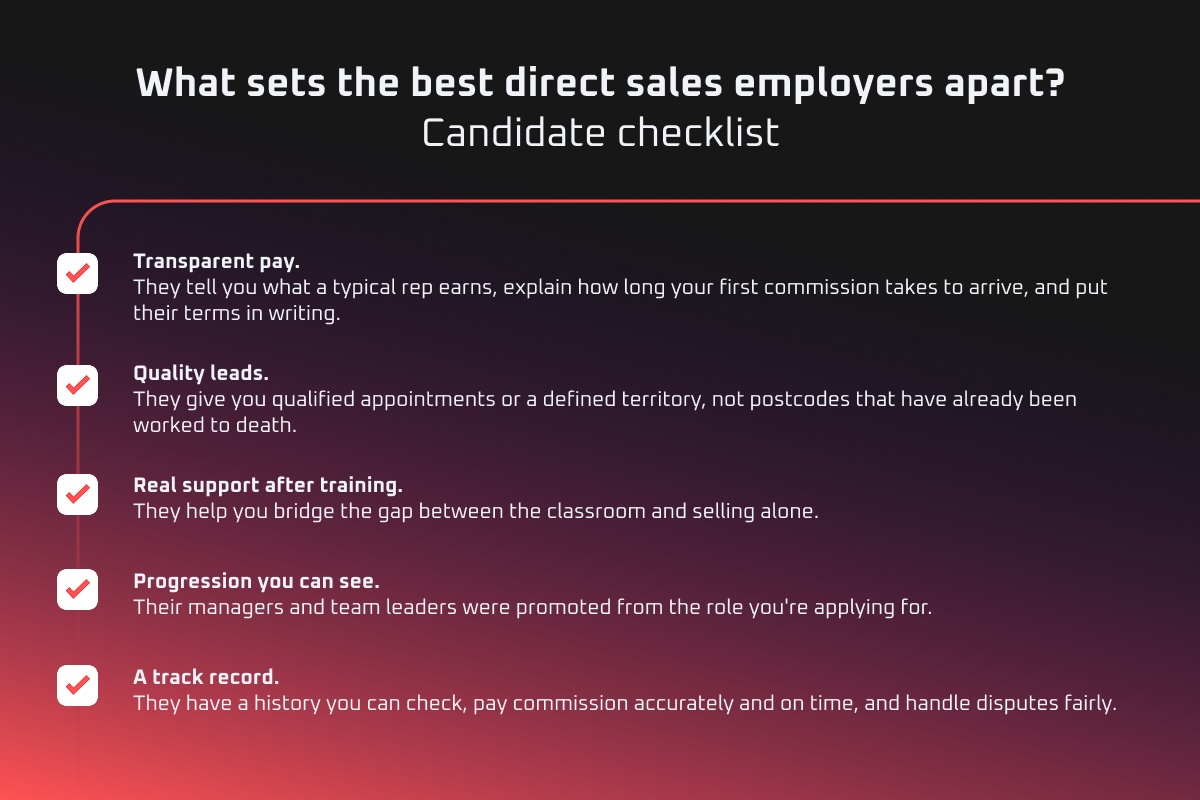
What sets the best direct sales employers apart?
A good direct sales employer gives you what you need to sell, protects your ability to earn and treats self-employed reps as commercial partners. Measure any business against these five standards:
• Transparent pay. They tell you what a typical rep earns, explain how long your first commission takes to arrive, and put their terms in writing.
• Quality leads. They give you qualified appointments or a defined territory, not postcodes that have already been worked to death.
• Real support after training. They help you bridge the gap between the classroom and selling alone.
• Progression you can see. Their managers and team leaders were promoted from the role you’re applying for.
• A track record. They have a history you can check, pay commission accurately and on time, and handle disputes fairly.
Direct sales vs MLM: know which one you’re joining
Before you go to an interview, be clear what kind of business you’re joining.
• Field direct sales: you represent a brand, such as a renewable energy installer, a home improvements business or a mobility specialist. The company usually supplies or generates leads, trains you on the product and pays you commission, or a basic plus commission, on what you sell. You don’t buy stock to resell, and you never have to recruit friends to hit target.
• MLM or network marketing: a large part of your income comes from recruiting other distributors into your “downline”. Distributors often buy starter kits or stock up front, and the structure rewards recruiting more than selling to genuine customers.
If you’re looking at party-plan or network businesses, check whether the company belongs to the Direct Selling Association, whose code of conduct covers buyback schemes and earnings claims. If a business asks you to buy stock to resell, or pays you mainly for recruiting, it isn’t the kind of field sales role this guide covers.
Employed or self-employed: which pay model suits you?
Your working arrangement affects your legal protections, your tax position and what you can rely on while your pipeline builds.
| Model | What you receive | What you give up | Best suited to |
| Employed (basic + commission) | A basic salary, sick pay, paid holiday and pension contributions, with commission on top | A smaller share of your income depends on your own results | Reps who want a guaranteed base and employment rights |
| Self-employed (commission only) | Earnings tied directly to your results, more say over how you work, business costs you can deduct from taxable profit | No guaranteed pay, no paid holiday or sick pay if you’re genuinely self-employed, and you carry your own business costs | Proven, self-directed sellers who want the biggest return on their effort |
Basic plus commission. An employed role gives you stability: a guaranteed base, holiday pay, sick pay and pension auto-enrolment, with commission on top. Commission structures vary between employers, so ask to see yours in writing.
Self-employed and commission only. Most of the field sales roles we recruit for are self-employed. For an experienced, self-directed seller, that can mean a far better living than a salary. How much say you have over your week varies by company, because some roles have set appointment times, so ask how your diary works. The real question is how you’ll cope with no pay floor while your pipeline builds.
Before you sign, look at both sides.
If you’re genuinely self-employed, you don’t get: paid holiday, statutory sick pay, a notice period, unfair dismissal protection, pension auto-enrolment or the minimum wage.
What you start getting: earnings tied directly to your results, more control over how you work, the chance to deduct business costs such as mileage from your taxable profit, and, where your agreement allows, the freedom to work with more than one company.
Expenses reduce your taxable profit, so you pay less tax. They must be genuine business costs, you need to keep records, and you pay your own tax and National Insurance through Self Assessment.
This is general information, not legal or tax advice.
How to read an OTE figure
On-target earnings (OTE) is the headline figure most direct sales adverts lead with. It’s also where many candidates get misled.
Picture an advert that says £85,000 OTE. Ask where that figure came from. Often it’s what the business’s best performer earned in their best year, not what a typical rep takes home. Few employers set out to mislead. The best case just becomes the baseline over time.
As our CEO Leena Parmar puts it:
“If an employer can’t tell you what an average rep earns, they either don’t know or don’t want you to.”
Before you accept, ask for:
• The median, not the maximum. What did the middle of the team earn over the last 12 months?
• Month three. What did the last person in this seat actually take home in their third month?
• Three scenarios. A strong first year, an average one and one that didn’t work out. An employer who’ll describe the third is one you can probably trust on the first.
• The lag. Commission is usually paid once a job clears, not when you make the sale. In our experience, that takes around 30 days in most direct sales roles, so ask when your first payment will land and plan for the gap.
For a sense of what’s realistic in your sector, compare the advert with realistic sales earnings by role. If a hiring manager can’t explain what an average rep takes home in month three in three plain sentences, treat the opportunity with caution. Our guide to how commission works in your first 90 days explains why.
Where do the leads come from?
Your earnings depend on your leads as much as your ability. A brilliant closer with poor leads will often earn less than an average closer with good ones. Find out how opportunities reach your diary:
• Pre-booked, qualified appointments. The employer runs the marketing, whether digital advertising, TV or a call centre. The customer has asked for a quote and agreed to a visit. This is common in home improvements and mobility.
• Warm or canvass-supported leads. Lead generators work ahead of you and create interest on the doorstep. You return to quote and close.
• Cold canvassing. You build your own pipeline by knocking on doors or cold calling. It can work, but it’s the hardest version of the job.
Then ask the employer: how many appointments can I expect each week? What’s the conversion rate on those leads? Is my territory mine alone, or are other reps working the same postcodes? A business that puts ten reps on a small patch dilutes every one of them.
What training and support should you expect?
Most employers train people well. The problem is what comes straight after: a course, a diary, a postcode and “off you go”. We call it the training cliff. The first time an appointment goes badly or a customer cancels, nobody helps you figure out what went wrong or how to bounce back from the rejection.
The employers worth working for build a bridge between training and selling alone:
• Field shadowing offered alongside an established top performer before you run appointments solo.
• A diary that builds as your confidence and closing rate grow, not full volume from week two.
• An open door, such as an offered check-in around week four to talk through what’s working and what isn’t.
Self-employed doesn’t mean unsupported. If a company expects you to run at full volume in week two with nobody to call, expect people to leave.
Is there a clear path to progression?
What happens after you’ve mastered your territory decides how long you stay. The best employers treat the field role as the start of something. Look at who runs the sales floor:
• Were the current regional directors and team leaders promoted from the field?
• How long has the management team been in place?
• Is there a route into coaching or team leadership?
If a company keeps bringing in managers from outside while its best reps have nowhere to go, you’re being offered a job rather than a career. You can also ask: how long has this territory been open, and why? Who was the last person in this role, and where are they now? A good employer answers both without hesitation. The figure on the offer letter pays for your first year. Everything else decides whether there’s a second.
How to check an employer’s reputation
Most candidates search Glassdoor, Indeed or Trustpilot before an interview. Reviews are worth reading, but look for patterns, not single reviews. Use them to decide what to ask, not what to think.
In our experience, the reasons people give for leaving a direct sales role early are fairly consistent: earnings that weren’t what they expected, too few appointments, unclear costs, too much travel, or not enough support. Most come down to a gap between the role as it was described and the role as it really works. That tells you what to look for in a review, and what to ask before you start.
Read vague complaints carefully.
• “Too much driving.” Field sales involves travel. The useful version names the size of the territory or who pays for fuel.
• “Commission is hard to earn.” Without knowing whether the rep had qualified appointments, this tells you little.
• “Long days.” Appointments happen when customers are home, which often means evenings and weekends.
Take repeated, specific complaints seriously.
• Late or disputed commission. Do several reviews mention missed payments, unfair deductions or clawbacks that were never explained?
• Unfair lead allocation. Do reviews say senior reps get the qualified appointments while new starters get the cold or distant ones?
• Misleading adverts. Do ex-reps say the role was advertised as “account management” or “marketing” and turned out to be door-to-door sales?
• The dates. Three identical complaints this quarter is a pattern. Three spread over six years, with none since, might be a company that has fixed the problem.
Take what you find into the interview and ask about it directly: “I’ve seen a couple of reviews mention late commission. What happened there?” A good employer answers straight away. A weak one gets defensive, and that tells you more than any star rating. You can also check Companies House for a company’s accounts, directors and how long it has traded.
Customer reviews are worth a look too. Companies completing hundreds of installations a month will pick up some complaints about fitting delays or supplier problems, and frustrated customers are more likely to post than happy ones. A low score doesn’t have to rule a company out, but ask yourself one question: could you look a customer in the eye and stand behind what you’re selling?
Red flags to walk away from
If you see any of these during the recruitment process, walk away, however good the number looks:
• Mandatory stock purchases. Any requirement to buy stock or store products at home.
• Income tied to recruitment. Earnings that depend on signing up new reps rather than selling to genuine customers.
• High-pressure hiring. An interviewer who won’t let you take the contract away overnight, or wants you to sign on the spot.
• Nothing in writing. Verbal promises about basic pay, fuel allowances or commission rates that don’t appear in the contract.
• Vague earnings claims. “£100k+ in your first year” with nothing behind it: no typical earnings, no conversion rates, no product pricing.
Questions to ask before you accept an offer
Never accept an offer on the headline commission rate alone. Ask these before you sign:
1. What’s my status, in writing? Employed, worker or self-employed?
2. Is it basic plus commission, or commission only?
3. What did your average rep earn last year? Ask for the median, not the best.
4. How many appointments will I get, and what do they convert at?
5. Who pays for leads, travel and training? Work out your costs before you start.
6. Can commission be clawed back? What happens if a customer cancels during the cooling-off period?
7. How long does the average rep stay? A 12-week retention figure is even better.
For more help preparing, read our advice for sales job seekers.
Find the right direct sales role
The right employer gives you realistic earnings, quality leads and professional respect. When you find one, direct sales can be a very rewarding career.
At Citrus Connect, we specialise in direct sales recruitment across home improvements, renewable energy and mobility. We ask every client how leads are allocated, how commission works and what support new reps get, so we can give you a straight answer before you apply.
Ready for a sales role with transparent numbers from day one? Explore our live direct sales jobs or register your CV, and a consultant will review it within 48 hours.
Frequently asked questions
What are the best direct sales companies to work for in the UK?
The best direct sales companies are open about what a typical rep earns, supply qualified leads and support new reps after training. They put their terms in writing, protect your territory and promote managers from the field.
Is direct sales a good career in the UK?
Yes, for self-motivated people with resilience and good communication skills. Strong performers can out-earn many salaried professionals. Long-term success depends on choosing an employer with a product worth selling, real investment in leads and fair pay practices.
What is the difference between direct sales and MLM?
In field direct sales, you earn by selling a company’s products or services directly to customers. In MLM, income relies heavily on recruiting other people into a network, and often involves buying stock up front.
Are commission-only sales jobs legitimate?
Yes. Commission-only roles are common in UK direct sales, particularly in home improvements and renewable energy. They’re legitimate when costs are explained up front, you aren’t buying stock to resell and you get a written contract.
How much do direct sales reps earn in the UK?
It depends on the product, commission rate, lead model and whether the role is employed or self-employed, which is why headline figures tell you so little. Ask for median earnings over the last 12 months and what a new starter took home in month three.
What should I ask a direct sales employer at interview?
Ask what the average rep earned last year, how many appointments you’ll get, who pays for leads and travel, how long the territory has been open and what the clawback terms are. Confirm in writing whether you’ll be employed, a worker or self-employed.